No products in the cart.
What is a VTOL Drone? The Ultimate Technical Guide to Vertical Takeoff and Landing UAVs
In the rapidly evolving world of unmanned aerial vehicles (UAVs), commercial enterprises, defense sectors, and engineering teams are constantly searching for the perfect flight platform. For years, operators faced a compromising choice between the long endurance of traditional airplanes and the operational flexibility of multirotors. However, the emergence of the VTOL drone has permanently shattered this compromise. Combining the runway-independent versatility of a helicopter with the aerodynamic efficiency of a high-speed airplane, these modern hybrid aircraft represent one of the most significant breakthroughs in aviation history. Whether utilized for mapping thousands of hectares of agricultural land, conducting critical industrial inspections, or delivering life-saving medical supplies to remote locations, understanding this technology is essential for anyone looking to scale aerial operations in the modern era.
Table of Contents
What does VTOL stand for in drones?
Answer for Featured Snippet: In the context of unmanned aerial vehicles, VTOL stands for Vertical Takeoff and Landing. A VTOL drone is a specialized class of aircraft capable of launching into the air and returning to the ground completely vertically—eliminating the need for a traditional runway, catapult, or launch rail—while utilizing aerodynamic wings to transition into high-speed forward flight once airborne.
The acronym VTOL captures the essence of a massive engineering paradigm shift. Historically, aircraft fell into two rigid categories: fixed-wing systems (which require forward velocity across a runway to generate lifting force over their wings) and rotary-wing systems (such as helicopters and quadcopters, which use continuous motorized propulsion to generate direct upward lift). By incorporating VTOL capabilities, a modern drone circumvents the primary limitations of both ancestral formats.
When analyzing a VTOL drone, it is important to recognize that the term does not merely mean “a drone that takes off straight up.” Technically, a standard consumer quadcopter takes off vertically. However, within the professional, industrial, and commercial drone sectors, “VTOL” specifically refers to hybrid configurations. These systems feature structural wings designed to carry the aircraft over immense distances, but utilize secondary or rotatable propulsion units to achieve hover capabilities during the launch and recovery phases of a mission.
This structural duality addresses a massive operational bottleneck. Traditional fixed-wing commercial UAVs require vast open fields for belly landings or expensive bungee launch systems that stress the airframe. Conversely, multirotors can operate out of confined spaces but waste significant battery energy fighting gravity rather than generating aerodynamic lift. The concept of VTOL represents the absolute convergence of these two distinct structural design models.
How do VTOL drones work?
To fully grasp how a hybrid VTOL drone operates, one must look closely at its structural dynamics, aerodynamic transformations, and complex internal flight control algorithms. The entire operational lifecycle of a professional VTOL platform relies heavily on its ability to execute three critical flight phases seamlessly: the Vertical Launch Phase, the Transition Phase, and the Fixed-Wing Cruise Phase.
1. The Vertical Launch Phase (The Rotary Mode)
When the system initiates its takeoff sequence, the automated flight controller engages the vertical lift motors. These motors generate direct downward thrust, overcoming the total weight of the aircraft to pull it cleanly off the ground. During this phase, the drone operates purely on the principles of multirotor physics. Sensors such as gyroscopes, accelerometers, and magnetometers continuously feed orientation data to the onboard computer, making micro-adjustments to individual motor speeds to keep the aircraft perfectly level against wind gusts. Because it operates entirely within a vertical envelope, the drone can launch from dense forests, rugged mountain ridges, small marine vessels, or tight industrial compounds.
2. The Transition Phase (The Aerodynamic Handshake)
Once the aircraft reaches a safe pre-programmed altitude (typically between 40 to 80 meters above ground level), the flight controller initiates the most complex phase of operation: the transition to forward flight. The drone engages its forward propulsion mechanism (a pusher or puller propeller). As the forward propeller spins up, the drone gains horizontal velocity. As the horizontal speed increases, air flows rapidly over the structural fixed wings, generating aerodynamic lift.
The internal flight control algorithm manages a delicate balance during this brief window. It gradually reduces power to the vertical lift motors while scaling up power to the forward cruise motor. The moment the forward velocity generates enough aerodynamic lift across the wings to fully support the drone’s weight, the vertical lift motors are shut down completely (and often locked aligned with the airflow to minimize drag). This transition phase demands hyper-precise software calibration; a minor miscalculation in stall speeds or pitch angles could cause the aircraft to lose altitude abruptly.
3. The Fixed-Wing Cruise Phase (The Efficiency Mode)
With the vertical lift systems completely offline, the aircraft flies solely as a traditional high-efficiency airplane. The energy required to maintain forward cruise is exponentially lower than the energy required to hover. A single forward motor maintains high-velocity cruising speeds while relying entirely on the wings to counteract gravity. When the mission is complete, the entire sequence is performed in exact reverse: the drone slows down, reactivates its vertical lift thrusters, halts forward momentum in mid-air, and descends safely into its designated landing zone with centimeter-level precision.
What is a fixed-wing VTOL drone?
Answer for Featured Snippet: A fixed-wing VTOL drone is a hybrid UAV that features rigid, airplane-like wings combined with multirotor lift mechanisms. It utilizes dedicated rotors to achieve vertical takeoff and landing, but once airborne, it relies entirely on its fixed wings to generate lift during high-speed forward cruise flight, ensuring unmatched operational range and battery efficiency.
The defining characteristic of this setup is its extreme energy efficiency. In fluid dynamics, a well-designed fixed wing offers an exceptional lift-to-drag ratio. Once the drone is in its cruising phase, it requires roughly 70% to 80% less battery or fuel power to move forward compared to a quadcopter of equivalent weight. This efficiency directly translates into remarkable operational capabilities, allowing these systems to fly for multiple hours and cover hundreds of kilometers on a single charge.
Key Structural Components of a Fixed-Wing VTOL System:
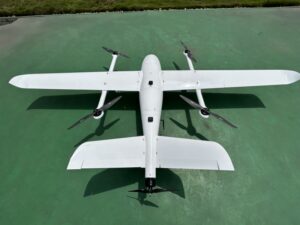
- The Main Wing Structure: High-aspect-ratio wings designed to maximize lift and minimize drag at specific cruising velocities. These wings often feature advanced control surfaces like ailerons or elevons to control roll and pitch.
- The VTOL Propulsion Boom: Carbon-fiber spars mounted perpendicular to the wings that house the vertical lift motors and ESCs (electronic speed controllers), ensuring structural rigidity during harsh takeoffs.
- The Fuselage Core: A streamlined center body designed to protect heavy sensors, internal avionics, communications links, and high-energy-density batteries or hybrid internal combustion engines.
By blending these components, a fixed-wing VTOL platform solves the historic logistical challenges of large fixed-wing aircraft. Traditional fixed-wing commercial UAVs require open spaces to land on their bellies, which frequently damages expensive optical payloads or mapping cameras upon contact with rough terrain. By transitioning into a vertical hover for landing, the fixed-wing VTOL completely eliminates landing impacts, safeguarding expensive sensors and significantly extending the total operational life of the airframe.
What are the types of VTOL drones?
Answer for Featured Snippet: The primary types of VTOL drones are Separate Lift and Thrust (SLT) systems, which use independent motors for hovering and forward cruise; Tilt-Rotor / Tilt-Wing systems, which utilize rotating mechanisms to change rotor angles; and Tail-Sitters, which sit vertically on their tails for launch and pitch forward 90 degrees for flight.
As the commercial drone industry has matured, aerospace engineers have developed several unique structural designs to achieve vertical takeoff and landing capabilities. Each design features a distinct mechanical layout, balancing tradeoffs between mechanical complexity, aerodynamic efficiency, wind resistance, and payload capacity.
1. Separate Lift and Thrust (SLT) Systems
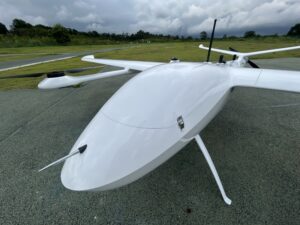
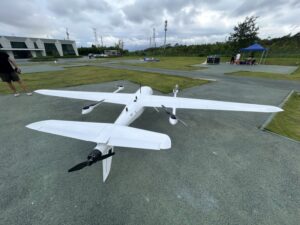
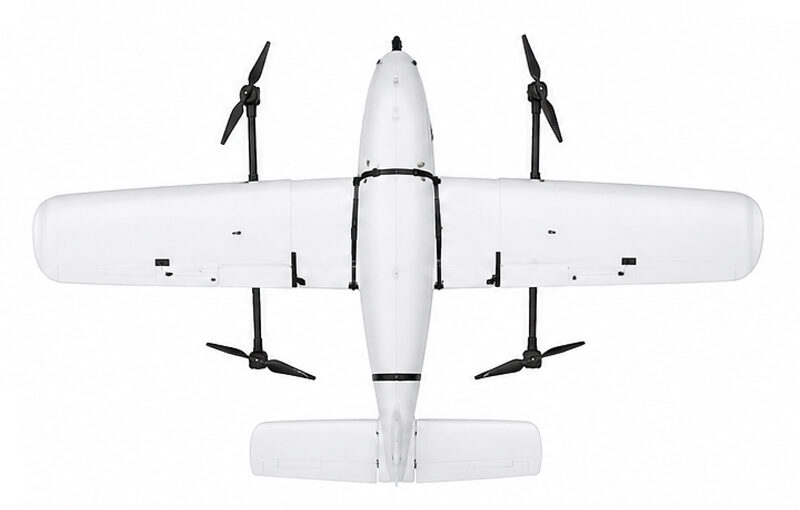
The Separate Lift and Thrust (SLT) configuration is mechanically the simplest and most widely used architecture in the commercial drone industry today. In an SLT drone, the vertical lift systems and the forward propulsion systems are entirely independent of one another. The aircraft features a standard fixed-wing layout with a dedicated pusher or puller motor at the rear or front for cruising. Additionally, it incorporates horizontal booms equipped with four or more dedicated vertical quadcopter-style motors.
During takeoff, only the quadcopter motors run. During cruise, only the forward propeller runs, and the quadcopter rotors remain completely stationary. The primary advantage of SLT is its extreme mechanical reliability; because there are no complex moving tilt-mechanisms or servos, there are fewer mechanical parts that can fail in mid-air. The distinct drawback, however, is dead weight and parasitic drag. During cruise flight, the four vertical motors and their associated structural booms serve no function, creating additional aerodynamic resistance that slightly lowers overall battery efficiency.
2. Tilt-Rotor and Tilt-Wing Systems
Tilt-Rotor and Tilt-Wing configurations utilize dynamic, moving propulsion units to achieve maximum aerodynamic efficiency. In a tilt-rotor system, the motors are mounted on motorized articulating hinges. During vertical launch, these motors rotate upward to face the sky, functioning exactly like a multirotor. Once the drone achieves its target altitude, the internal servos gradually rotate the entire motor assembly 90 degrees forward, transforming the lifting rotors into traditional pulling propellers.
In a tilt-wing system, rather than tilting just the motors, the entire structural wing assembly rotates 90 degrees from a vertical orientation to a horizontal orientation. The massive benefit of these designs is that every single motor is utilized during both hover and cruise, eliminating the “dead weight” issue found in SLT configurations. This makes tilt-rotor systems highly efficient and capable of reaching much higher top speeds. However, they are highly complex to engineer. The tilting mechanisms, mechanical joints, and heavy-duty servos add clear failure points and require incredibly advanced flight control software to manage safely during high-wind transitions.
3. Tail-Sitter Configurations
A Tail-Sitter is a highly unorthodox but remarkably elegant class of aircraft. A tail-sitter drone does not feature articulating motors or separate propulsion groups. Instead, the entire aircraft sits vertically on its tail structure on the launch pad, pointing straight up toward the sky. When it takes off, it flies upward like a miniature rocket or vertical multirotor. Once it reaches operational height, the entire body of the aircraft pitches forward 90 degrees to enter horizontal cruise flight.
Tail-sitters are highly praised for their mechanical simplicity. They require no moving motor hinges, no additional booms, and no redundant propulsion sets, resulting in an incredibly lightweight airframe that can carry large battery arrays or heavier cargo. However, they present massive operational challenges during high winds. Because the entire wing is exposed to crosswinds while sitting vertically on the ground or during vertical descent, tail-sitters can easily become unstable or get blown off course during landing, requiring highly skilled autopilot tuning to operate reliably.
Technical Comparison of UAV Configurations
To help drone operators and engineering teams make informed purchasing and deployment decisions, the table below provides a comprehensive breakdown of how modern hybrid systems compare to ancestral fixed-wing and multirotor platforms across key operational performance metrics.
| Performance Metric | Traditional Multirotor | Traditional Fixed-Wing | Hybrid VTOL Drone |
|---|---|---|---|
| Runway / Launch Space Requirement | None (Vertical launch) | High (Requires runway, catapult, or hand launch) | None (Vertical launch) |
| Flight Endurance & Range | Low (Typically 20–40 minutes) | Very High (Multiple hours) | High to Very High (1 to 3+ hours) |
| Payload Protection During Landing | Excellent (Soft vertical touchdown) | Poor (High risk of belly-landing damage) | Excellent (Soft vertical touchdown) |
| Mechanical Complexity | Low (Few moving components) | Medium (Ailerons, flaps, elevators) | High (Multiple motor sets / tilt-servos) |
| Hovering Capability | Excellent (Stationary pinpoint hover) | None (Must maintain forward movement) | Excellent (Can hover during launch/recovery) |
| Wind Resistance (Takeoff/Landing) | High | Medium | Medium to High (Depends on configuration) |
Practical Advantages and Industrial Applications
The combination of vertical takeoff precision and extended flight range has unlocked massive financial and operational advantages for industries that rely heavily on geospatial data, inspection frameworks, and rapid long-distance logistics.
1. Large-Scale Mapping, Surveying, and GIS
In surveying and geospatial engineering, efficiency is measured in hectares per hour. Traditional multirotor platforms can map only a limited area before their batteries deplete, requiring operators to set up multiple launch sites and perform frequent battery swaps. A fixed-wing VTOL platform can map thousands of acres in a single flight. Because it carries high-resolution photogrammetry cameras, multispectral sensors, or heavy LiDAR payloads over long distances while flying at stable, high altitudes, it produces hyper-accurate digital twin models and topographic maps at a fraction of the traditional cost and time.
2. Linear Infrastructure Inspection
Inspecting thousands of miles of high-voltage power lines, oil pipelines, and railway tracks is an incredibly demanding task. Multirotors are too slow to cover these vast linear networks effectively, while traditional manned helicopters are prohibitively expensive and present safety hazards. Commercial operators deploy hybrid aircraft equipped with advanced optical sensors and thermal cameras to perform long-distance automated linear inspections. These aircraft navigate pre-mapped corridors for hours, automatically flagging structural anomalies, corridor vegetation overgrowth, or pipeline thermal leaks without human intervention.
3. Remote Medical and Cargo Logistics
Time is a critical factor in healthcare logistics. In remote or mountainous regions where road infrastructure is poor or nonexistent, standard delivery vehicles can take hours to move critical medical supplies. Hybrid delivery aircraft are transforming this sector. They can take off from a centralized urban hospital repository, fly over rugged terrain at high speeds, and land directly inside a tight, remote clinic courtyard to deliver blood plasma, vaccines, or anti-venoms within minutes. This capability is actively saving lives in rural regions globally.
4. Precision Agriculture and Forestry Management
Modern forestry management and large-scale industrial agriculture require frequent, detailed scans of vegetation health. Equipped with advanced multispectral cameras, hybrid aircraft can cover sprawling agricultural operations in a single afternoon. The resulting data allows agronomy teams to detect localized crop stress, track invasive pest infestations, optimize fertilizer distribution, and accurately calculate total timber volume across thousands of hectares of thick, commercial forests.
Frequently Asked Questions (FAQ)
Q1: Can a VTOL drone hover indefinitely like a regular quadcopter?
No, a hybrid system cannot hover indefinitely. While it is structurally capable of hovering, its vertical lift motors consume an immense amount of battery energy. The aircraft is designed to hover for only 1 to 2 minutes during launch and landing. If forced to hover for extended periods, the battery will deplete rapidly, eliminating the long-range benefits of the fixed-wing design.
Q2: What happens if a motor fails during the transition phase?
Modern commercial platforms feature redundant safety protocols within their flight control software. If a vertical lift motor fails during the transition phase, advanced systems can immediately abort the forward transition and use the remaining lift motors to guide the aircraft safely back down to earth. Conversely, if a forward motor fails, the drone can instantly reactivate its vertical hover motors and perform an emergency landing on the spot.
Q3: Are VTOL drones more difficult to fly than standard quadcopters?
From the pilot’s perspective, they are remarkably simple to fly because they are completely automated. The complex mechanical adjustments, motor transitions, and wind compensation are handled entirely by the onboard flight controller. Pilots simply design a mission plan on a ground control station tablet, press launch, and watch the system execute the takeoff, mapping flight, and landing fully autonomously.
Q4: What is the average flight time of an industrial VTOL drone?
The flight time varies based on the propulsion system and payload. Purely battery-powered (electric) systems typically achieve flight times between 60 to 120 minutes. Advanced systems utilizing gas-electric hybrid engines or hydrogen fuel cells can easily fly for 3 to 5 hours continuously, making them incredibly powerful assets for ultra-long-range missions.