No products in the cart.
Selecting the right unmanned aerial vehicle (UAV) platform for commercial, industrial, or research applications is one of the most critical decisions an enterprise operations manager can make. The drone market is no longer populated merely by hobbyist toys; it is a highly specialized landscape driven by efficiency, payload capacities, and specific data-gathering requirements. For years, the traditional multirotor quadcopter dominated the commercial landscape due to its simple flight controls and excellent hovering capabilities. However, as missions scale up to require broader geographical coverage, the VTOL drone has emerged as a disruptive technological force. To optimize your hardware investments and ensure mission success, operators must analyze the fundamental differences between these platforms, understand structural engineering dynamics, and map out exactly which aircraft aligns with their long-term operational workflows.
Table of Contents
VTOL drone vs quadcopter: Which is better?
Answer for Featured Snippet: When comparing a VTOL drone vs quadcopter, neither is universally “better” because their performance depends entirely on the mission profile. A VTOL drone is superior for large-scale operations requiring long flight endurance (1–3+ hours) and vast area coverage, such as corridor mapping or linear inspection. A quadcopter is better for close-range, high-precision tasks in confined spaces (20–40 minutes), such as structural inspections, cinematography, or thermal imaging of singular buildings.
To determine whether a hybrid vertical takeoff plane or a quadcopter is ideal for your organization, we must move past generalized marketing slogans and look at the physics governing both systems. The quadcopter relies completely on dynamic thrust generated by four spinning propellers. Because it must spin its rotors continuously to fight gravity, a quadcopter operates at a very high energy-consumption rate. This fundamental design means its average flight time is structurally bottlenecked, typically capping out between 25 and 45 minutes depending on the payload weight and battery configuration.
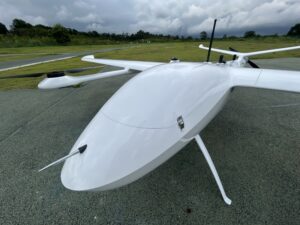
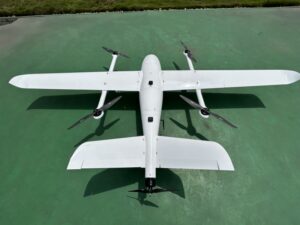
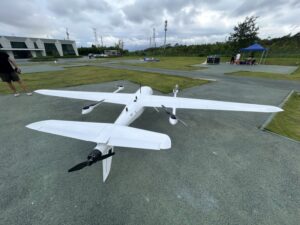
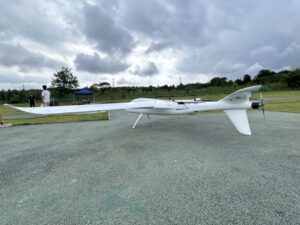
Conversely, a hybrid VTOL aircraft utilizes a dual aerodynamic strategy. It uses multiple vertical thrusters to lift off like a quadcopter, but transitions into horizontal flight where its fixed structural wings generate lift. Once the wings take over the burden of lifting the aircraft, the drone turns off its vertical thrusters and uses a single energy-efficient cruise motor to glide through the air at high velocities. This architectural difference allows a hybrid system to achieve flight times often exceeding 2 to 3 hours, covering ten to fifteen times more geographical territory on a single battery charge than a standard quadcopter.
However, this massive leap in range introduces tradeoffs in mechanical complexity and maneuvering flexibility. A quadcopter can stop instantly in mid-air, rotate flawlessly on its vertical axis, and fly backward or sideways through tight gaps between buildings or heavy industrial machinery. A hybrid aircraft cannot perform complex, nimble maneuvers during its forward cruise phase; it requires a wide turning radius and cannot fly backward or sideways when operating as a fixed-wing plane. Therefore, for missions that demand operating in close proximity to complex structures—such as cell tower inspections or bridge under-girding analysis—the quadcopter remains the undisputed champion. For large-scale data harvesting, the hybrid platform easily wins.
Difference between fixed-wing and VTOL drones
Answer for Featured Snippet: The primary difference between fixed-wing and VTOL drones lies in their launch and landing mechanisms. A traditional fixed-wing drone requires a runway, catapult launcher, or hand-launch to achieve takeoff, and relies on belly-landings or parachutes to recover. A VTOL drone incorporates integrated vertical thrusters, allowing it to take off and land straight up and down in confined areas while maintaining the same high-speed fixed-wing cruise efficiency once airborne.
While the terms “fixed-wing” and “VTOL” are frequently used interchangeably by commercial operators, they represent distinct evolutionary steps in aerospace engineering. A traditional fixed-wing UAV is modeled directly after a classic passenger airplane. It features a rigid fuselage, two large primary wings, and a single propulsion engine. Because it has no vertical lifting propellers, it cannot stay in the air without maintaining constant forward velocity. This structural limitation creates substantial operational barriers: before you can launch a standard fixed-wing system, your crew must find a long, unobstructed stretch of land to act as a runway, or carry cumbersome, heavy-duty mechanical catapult launch systems into the field.
Furthermore, recovering a traditional fixed-wing aircraft is notoriously stressful. Without a runway, these drones must perform a “belly landing”—essentially sliding across the grass or dirt until friction brings them to a halt—or deploy a localized parachute system. Belly landings subject the airframe to continuous structural stress and vibrations. Over time, these hard impacts can crack composite carbon fiber structures or misalign the delicate internal lenses of expensive payloads, such as high-end LiDAR sensors or multispectral cameras. Parachute landings reduce impact force but leave the drone vulnerable to crosswinds, which can blow the descending aircraft into nearby trees, power lines, or bodies of water.
A hybrid VTOL platform completely eliminates these logistical headaches by embedding multirotor propulsion directly into the fixed-wing framework. It retains all the incredible long-range aerodynamic advantages of the traditional airplane structure but adds the ability to hover during launch and recovery. This means you get the best of both worlds: you no longer need launchers, catapults, runways, or risky belly landings. The drone takes off smoothly from a small 3×3 meter clearing, rises to a safe altitude, flies its long-range mission as an efficient airplane, and then returns to execute a soft, pinpoint touchdown that keeps your high-value sensors completely insulated from physical impacts.
Why choose a VTOL drone over a multirotor?
For organizations looking to scale up from basic consumer-grade equipment to a professional industrial fleet, understanding the exact financial and operational reasons to invest in a hybrid platform over a traditional multirotor is critical. While multirotors are highly accessible and cost-effective for localized missions, they fail to deliver when pressed into heavy industrial workflows.
1. Exponentially Greater Area Coverage (Hectares Per Flight)
In commercial data collection—whether for open-pit mining volumetric calculations, topographic land surveying, or agricultural monitoring—efficiency is directly tied to how many hectares can be mapped per hour. Because a multirotor flies slowly and consumes immense energy just to stay aloft, it can map only a tiny fraction of land before its batteries drain. A hybrid aircraft flies at cruising speeds that are often double or triple that of a quadcopter. Combined with its multi-hour battery life, a single hybrid flight can cover an area that would require eight to ten separate multirotor battery cycles. This drastically reduces field operational time, lowers labor costs, and allows you to complete projects days ahead of schedule.
2. Superior Payload Stability and Sensor Efficiency
Multirotors pitch, roll, and tilt their entire body constantly to move forward or fight crosswinds. This perpetual tilting motion forces the mechanical camera gimbal to work continuously to stabilize the sensor, which consumes extra power and can introduce minor data inaccuracies during high-resolution mapping runs. A hybrid fixed-wing system flies along a smooth, level plane during its data collection phase. The airframe remains highly stable, allowing sensors like LiDAR scanners to pulse downward with maximum consistency, resulting in cleaner data point clouds and superior orthomosaic stitching.
3. Mitigating the Risks of Complex Terrain
Operating a drone in rugged environment—such as steep mountain valleys, dense jungles, or offshore wind farms—presents major logistical hazards. A multirotor operator must remain close to the target area because of the platform’s short range, which often means trekking deep into dangerous terrain to maintain a line of sight. A long-range hybrid UAV can be launched from a safe, easily accessible base station miles away, fly over rugged terrain to gather data, and return to base autonomously. It completely eliminates the need to transport crews into hazardous zones just to get within range of a localized quadcopter.
4. True BVLOS (Beyond Visual Line of Sight) Readiness
As aviation authorities worldwide establish clear regulatory frameworks for BVLOS flights, the hybrid platform stands out as the natural hardware choice for long-distance operations. Whether tracking miles of linear oil pipelines, conducting border security patrols, or managing delivery networks, a multirotor simply lacks the speed and range required to execute true BVLOS operations at scale. Investing in hybrid technology ensures your commercial drone program is fully future-proofed for the next generation of aviation permissions.
Head-to-Head Technical Comparison Table
To provide a clear, concise breakdown for executive decision-makers, the following table details the key performance and operational characteristics of these competing drone architectures side-by-side.
| Feature / Operational Metric | Standard Quadcopter / Multirotor | Traditional Fixed-Wing UAV | Hybrid VTOL Drone |
|---|---|---|---|
| Average Flight Time Range | 20 – 45 Minutes | 60 – 180+ Minutes | 60 – 150+ Minutes |
| Cruising Velocity (Speed) | Low (10 – 15 m/s) | High (20 – 30 m/s) | High (18 – 28 m/s) |
| Launch Footprint Required | Minimal (3×3 meters) | Large (Clear runway or launch rail) | Minimal (3×3 meters) |
| Mid-Air Hover Capability | Perfect (Unlimited duration) | None (Must maintain forward flight) | Excellent (Limited duration for safety) |
| Mechanical Complexity & Parts | Low (Fewer moving joints) | Medium (Control surfaces/servos) | High (Multiple motors and transition linkages) |
| Sensor Protection Level | High (Soft vertical landings) | Low to Medium (Belly-landing friction) | Excellent (Zero landing friction) |
| BVLOS Mission Suitability | Poor (Severely range-limited) | Excellent | Excellent (Optimized for long-range) |
Mission Matching Guide: Which Configuration Wins?
To maximize your return on investment, your drone choice should match the specific geometry and data needs of your primary projects. Let us look at common commercial use cases to see which platform provides the optimal operational solution.
Scenario A: Linear Infrastructure Inspection (Winner: VTOL Drone)
If your primary mission is inspecting hundreds of miles of high-voltage power grids, railway tracks, or oil pipelines, a multirotor quadcopter is highly inefficient. It would require your crew to drive along the corridor, stopping every few miles to swap batteries and relaunch the aircraft. A hybrid fixed-wing system can be launched from a single point, travel 50 miles down the pipeline corridor gathering continuous thermal and visual data, and return to base on a single charge. This significantly optimizes your daily data workflows.
Scenario B: Close-Range Structural Inspection (Winner: Quadcopter)
If your project involves inspecting a multi-story concrete dam face, a cell tower, or the undersides of a highway bridge, a fixed-wing hybrid system cannot safely complete the mission. Because it must maintain continuous forward momentum during flight, it cannot stop to analyze a crack or hover safely inches away from structural beams. A quadcopter can hover indefinitely, adjust its position by centimeters, tilt its camera payload up or down, and operate safely within tight, confined spaces.
Scenario C: Large-Scale Topographic Surveying & Lidar Mapping (Winner: VTOL Drone)
When mapping massive areas—such as a 5,000-hectare forestry project or a sprawling open-pit mine site—data consistency is crucial. A quadcopter struggles in high winds, and its short battery life breaks your data down into dozens of small, disconnected flight logs. A hybrid fixed-wing aircraft glides smoothly through high winds, covering immense territory in a single, continuous flight pattern. This produces highly uniform data sets that make stitching orthomosaics and processing LiDAR point clouds much simpler and more accurate.
Frequently Asked Questions (FAQ)
Q1: Why are VTOL drones generally more expensive than standard quadcopters?
Hybrid fixed-wing systems require highly advanced aerospace engineering, specialized carbon-fiber composite manufacturing, more complex internal flight controller electronics, and dual-propulsion setups (both vertical and forward motors). Additionally, they carry higher-grade industrial autopilots and long-range communication links, which naturally increases their price point compared to mass-produced consumer or basic industrial quadcopters.
Q2: Can a VTOL drone fly safely in high wind conditions?
Yes, modern industrial hybrid aircraft are built to handle strong winds, often matching or exceeding the wind tolerances of traditional quadcopters during their cruise phase. However, operators must pay close attention during the critical transition phase. If wind gusts are exceptionally strong during the launch or landing windows, the broad surface area of the fixed wings can catch the wind, requiring an advanced autopilot system with high-torque motors to maintain stability.
Q3: How much training does a pilot need to operate a commercial hybrid drone?
While the internal software physics are highly complex, the end-user pilot experience is almost completely automated. Operators do not fly the drone manually with dual sticks like a hobby craft. Instead, they use advanced Ground Control Station (GCS) software to map out a flight path. The software manages the takeoff, transition, cruise, and landing fully autonomously. However, pilots still require thorough training to manage emergency protocols, monitor airspace regulations, and override the autopilot if safety hazards arise.
Q4: Can I convert my existing quadcopter into a fixed-wing VTOL drone?
While some hobbyists build custom DIY conversions using open-source autopilots like ArduPilot, it is not recommended for professional or commercial operations. Industrial hybrid platforms require carefully calculated structural aerodynamics, internal component weight distribution, and extensive wind-tunnel testing to ensure structural integrity and flight safety. For commercial applications, using an engineered, factory-built platform is essential to ensure reliability and safety compliance.